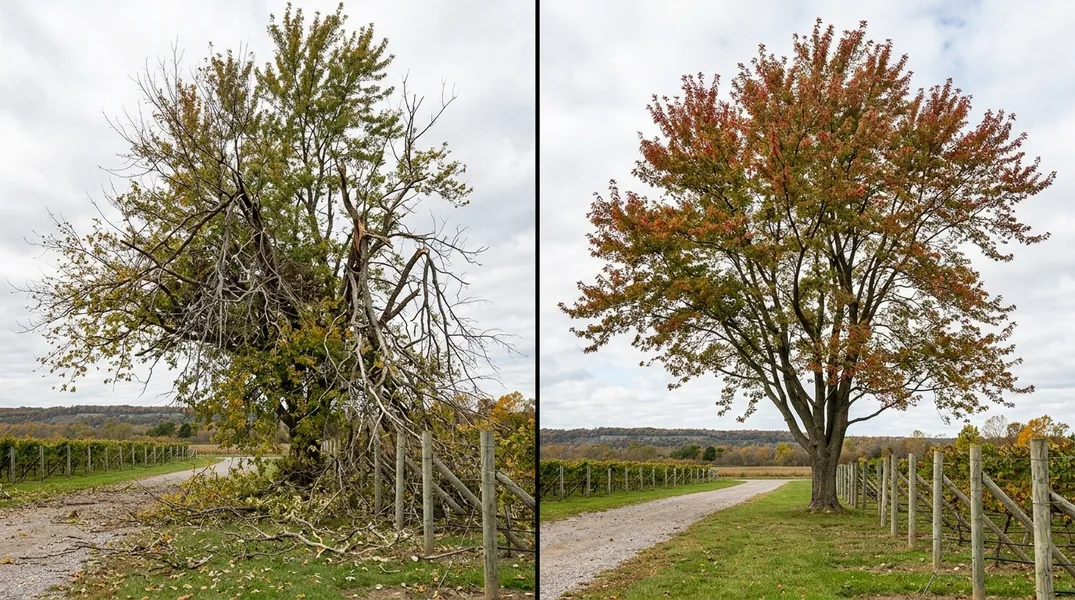
Winter Weather Threats to Niagara Trees
The winter season brings unique challenges to homeowners across St. Catharines. Ice storms and lake-effect winds create conditions that stress even mature, healthy trees. When ice accumulates on branches, the added weight can exceed what the wood can support, particularly on species like silver maples that dominate many residential properties in the region.
Lake wind presents a second threat. The proximity to the Great Lakes means that St. Catharines experiences stronger gusts than inland areas, especially during winter months. Trees with weak branch structure, previous damage, or poor root systems become vulnerable to snapping or uprooting. A tree that stands perfectly fine in autumn may fail spectacularly when ice and wind combine on a single winter night.
Understanding these risks is the first step towards protecting your property and family. Many homeowners assume their trees will survive because they have survived previous winters, but cumulative stress, age, and hidden decay change the equation every year.
Ice Storm Tree Damage: What Happens to Silver Maples and Other Species
Silver maples are particularly vulnerable during ice storms. Their wood is softer than that of sugar maples or oaks, and their branch structure tends to be more horizontal and spreading. When a heavy ice load settles on these spreading limbs, the leverage created at the branch collar becomes extreme. A silver maple split under ice is a common sight across Niagara after a major winter event, often resulting in a tree that is either dead or permanently disfigured.
Other species suffer differently. Ash trees, already stressed by emerald ash borer pressure in some areas, can lose entire limbs. Birches may bend dramatically under ice weight but sometimes recover if the ice melts without the branch breaking. The outcome depends on the tree's age, health, the thickness of accumulated ice, and how quickly temperatures rise afterward.
The real danger emerges when a branch fails mid-storm or when tree removal becomes necessary because the damage is too severe to repair. Trees fell on houses in St. Catharines are not rare during ice events, and the financial and safety consequences are substantial. Homeowners insurance often does not cover preventable damage that results from neglected tree maintenance.
Preventive Pruning Before Winter: Your Best Defence
Preventive pruning before winter in Niagara is the most cost-effective way to reduce risk. Removing dead, diseased, or weakly attached branches before the season arrives eliminates the limbs most likely to fail under ice or wind stress. Tree pruning performed in late autumn or early winter also removes crossing branches and improves the overall structure of the crown, allowing wind to pass through more easily rather than catching the entire canopy like a sail.
The goal of preventive pruning is not to remove large amounts of foliage, but to target specific problem areas. A certified arborist can identify which branches pose the greatest risk and which can be safely removed without harming the tree's health or appearance. This selective approach preserves the tree's natural form while dramatically reducing failure likelihood during severe weather.
Trees with multiple stems, poor crotch angles, or previous storm damage benefit most from this work. If you notice branches rubbing together, limbs that hang over your roof or driveway, or sections of dead wood, these are clear candidates for removal. Addressing these issues now prevents the need for emergency tree removal after a storm has already struck.
Hazard Tree Assessment: Know Your Risk
A hazard tree assessment Niagara evaluates whether a tree poses a genuine threat to people, structures, or utilities on your property. This assessment goes beyond a casual glance. A qualified arborist examines the tree's overall health, structural integrity, root condition, and proximity to targets like your house, garage, deck, or power lines. They also consider the tree's species, age, and how it responds to local weather patterns.
Not every tree near your home is a hazard. A healthy oak standing 15 metres from your house may be perfectly safe, while a smaller but diseased maple hanging directly over your bedroom window may pose serious risk. The assessment provides clarity and helps you prioritize which trees need immediate attention and which can be monitored. This information also supports any permit application or insurance claim, since it documents the condition of the tree before a failure occurs.
Lake wind tree damage assessments are particularly valuable in St. Catharines, where wind speeds and ice loads differ from inland regions. An arborist familiar with local conditions can identify which trees are most vulnerable to these specific threats and recommend targeted solutions, whether that means pruning, cabling and bracing, or removal.
Emergency Tree Removal When Storms Strike
Despite best efforts at prevention, storms sometimes cause damage that requires immediate action. A tree fell on a house, a large limb hangs precariously over a power line, or a tree is completely uprooted across your driveway. In these situations, 24/7 emergency tree removal becomes necessary to restore safety and access to your property.
Garden City Tree Trimming responds to emergency calls throughout the St. Catharines area. Our crews are trained to work safely around damaged structures, power lines, and unstable trees. We document the damage thoroughly, which helps when you file an insurance claim. We also handle the complete removal and cleanup, so you are not left with debris or hazardous wood scattered across your yard.
The cost of emergency removal is typically higher than planned, preventive work because of the urgency, the unpredictable nature of the job, and the additional safety precautions required. This is yet another reason why investing in preventive pruning and hazard assessment before winter is wise. A single emergency call can cost thousands of dollars, whereas preventive maintenance costs far less and eliminates most risk.
Preparing Your Trees for Winter: A Practical Checklist
Start your winter preparation now. Walk around your property and look for branches that are dead, diseased, or hanging over structures. Check for branches with poor crotch angles, where two limbs join at an acute angle and are likely to split under stress. Look for signs of decay, such as cavities, fungal growth, or bark damage. If your tree has been topped or heavily pruned in the past, its structure may be compromised and it may need professional assessment.
Contact Garden City Tree Trimming at (289) 273-4978 to schedule a free estimate and hazard assessment. Our ISA Certified Arborists will evaluate your trees, explain the risks, and recommend specific actions. We can handle tree trimming, pruning, cabling and bracing, or removal, depending on what your trees need. We work year-round and can often fit preventive jobs into our schedule before the heaviest ice and wind events arrive.
Winter storms in the Niagara region are inevitable, but the damage they cause is not. By taking action now, you protect your home, your family, and your investment in the trees that shade and define your landscape. The time to prepare is before the first ice storm, not after a tree has already failed.
Looking for a professional in St. Catharines? Garden City Tree Trimming responds quickly for all your tree trimming needs.
Get a free estimateOur services : Tree Removal · Tree Trimming · Tree Pruning