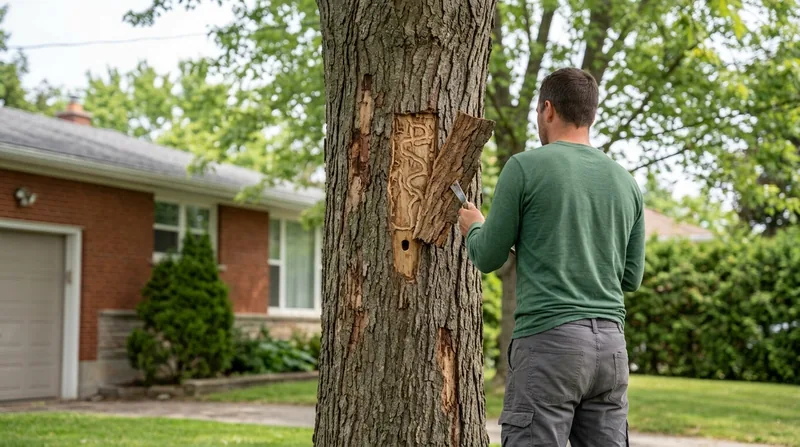




Emerald Ash Borer Treatment in St. Catharines is a time-sensitive service that protects ash trees still healthy enough to save from a destructive insect that has been established across this peninsula for years. The emerald ash borer (EAB) kills ash trees by disrupting their vascular system, and once a tree shows decline, treatment becomes impossible. Our ISA Certified Arborists assess each ash on your property and recommend either trunk-injection treatment to extend its life or a staged removal and replacement plan when infestation has gone too far. Early intervention is the only way to preserve mature ash trees in the St. Catharines area.
The emerald ash borer arrived in in St. Catharines and the surrounding area over a decade ago and has eliminated countless ash trees across residential neighbourhoods and ravine lots. Many homeowners in St. Catharines, Lincoln, Grimsby and Pelham are now facing the choice between treatment and removal. We help you make that decision based on tree health, location risk and long-term landscape goals. Contact us for a free estimate and we will assess your ash trees at no cost.
Why Emerald Ash Borer Treatment Matters in the St. Catharines Area
Ash trees are common in in St. Catharines and the surrounding area and many properties in the St. Catharines area have one or more on their land. Once the emerald ash borer colonizes an ash tree, the tree dies within three to five years. Without treatment, you lose the tree's canopy, its shade, its property value contribution, and you face costly removal later. Early detection and trunk-injection treatment can buy a healthy ash five to seven additional years, giving you time to plan replacement plantings or decide on removal on your schedule rather than the pest's.
Treatment is most effective on trees showing no more than 30 per cent canopy dieback and no visible exit holes. Once a tree is heavily infested, injection will not save it. Our arborists inspect the trunk, count exit holes, assess branch health and recommend the best path forward.
- We inject systemic insecticide into the tree's vascular system to poison larvae feeding inside the wood.
- Treatment protects the tree for one to two years and requires renewal every two years for ongoing defence.
- We document the tree's condition before and after treatment so you have a clear record for insurance and property files.
- We advise on companion trees at risk and help you plan a replacement ash or alternative species suited to your yard and soil.
Early treatment is far less expensive than removal and stump grinding, and it preserves the mature canopy that took decades to establish.
Local insight: In a typical St. Catharines neighbourhood, a mature ash tree costs $800 to $1,200 to remove and grind, plus $500 to $800 for a replacement sapling. Early injection treatment at $300 to $500 per application can defer that cost by five to seven years and may eliminate it entirely if the tree survives long enough for natural population collapse of the borer.
How We Treat Ash Trees for Emerald Ash Borer
Our treatment protocol begins with a thorough assessment in late spring or early summer, when EAB larvae are actively feeding and the tree's vascular system is most responsive to insecticide uptake. We inspect the trunk for exit holes (small D-shaped openings), check branch dieback, and measure the tree's diameter to calculate the correct injection dose. If the tree qualifies for treatment, we proceed immediately.
The injection process takes one to three hours depending on tree size. We use a pressurized system to deliver systemic insecticide into the tree's sapwood, where it circulates throughout the crown and protects against larvae for one to two seasons. We clean up all equipment and debris on site and provide you with a treatment record and a two-year reminder schedule.
- We assess the ash tree's health status, measure its diameter, and count visible emerald ash borer exit holes.
- We calculate the correct insecticide dose based on tree size and inject it into pre-drilled sapwood ports using calibrated pressure.
- We seal injection ports with wound dressing to prevent disease entry and pest reinfestation at the wound site.
- We schedule a follow-up inspection one year later to confirm treatment effectiveness and plan the next application.
- We provide written documentation of the tree's condition and treatment history for your records and insurance file.
Treatment is most effective when done consistently every two years for three to four cycles. After that, you can assess whether the tree has survived long enough to stop treatment or if removal is now the better choice.
Real example: A Port Dalhousie homeowner had a 60-centimetre ash showing 20 per cent canopy dieback and fresh exit holes. We injected in June 2023. The tree recovered, produced new growth, and showed no new borer activity at the one-year check. A second injection in June 2024 cost $400. Without treatment, removal would have cost $1,100 plus stump grinding at $300.
Treatment Methods and When to Use Them
| Method | Description | Best for |
|---|---|---|
| Trunk injection | Systemic insecticide delivered into sapwood; protects for one to two years. | Healthy ash with less than 30 per cent canopy dieback; early detection. |
| Staged removal | Remove the ash tree and grind the stump; plant a replacement species suited to local soil and climate. | Heavily infested ash; trees blocking hydro lines; ash in high-risk locations near structures. |
| Monitoring without treatment | Annual inspection to track borer activity and tree decline; removal when tree safety becomes a concern. | Low-value ash; trees near property lines where removal is inevitable; ash already in advanced decline. |
| Preventive injection on companion ash | Treat healthy ash trees near infested ones to slow spread and preserve the canopy longer. | Multiple ash on one property; ravine lots with dense ash stands; shared tree lines between neighbours. |
The choice between treatment and removal depends on the tree's health, its location on your property, and your landscape goals. Our ISA Certified Arborists will recommend the approach that gives you the best outcome. Contact us at (289) 273-4978 for a site visit and written recommendation.
Regulatory and Safety Considerations in St. Catharines
The City of St. Catharines may require a permit for a private tree removal, and the application is normally supported by an arborist report. Rules and thresholds differ from one municipality to the next across the St. Catharines area, so it is wise to check with your local planning department before removing a large ash. We can provide a detailed arborist report documenting the tree's condition, the emerald ash borer infestation level, and the recommendation for treatment or removal. This report supports your permit application and clarifies the decision for your insurer and property file.
If your ash is near your home's electrical service entrance, we maintain safe approach distances and never work on the public distribution network operated by your local utility or Hydro One. If an ash is touching or very close to hydro lines, we refer the situation to your local utility for clearance assessment before we proceed with treatment or removal.
Treatment injection is safe for the homeowner and the surrounding landscape. We use approved systemic insecticides registered for use on ash trees in in St. Catharines and the surrounding area. The insecticide circulates inside the tree and does not leach into soil or groundwater in harmful concentrations. No special site preparation or cleanup is required beyond routine yard care.
We are a fully insured, local company operating in St. Catharines and the surrounding area since 2015. Our crew carries comprehensive liability coverage for all treatment work, and we document every job with photos and written notes. If you need an ash tree removal instead of treatment, we handle that as well with the same professional standard.
When to Schedule Emerald Ash Borer Treatment
Emerald ash borer injection is most effective when scheduled in late spring and early summer, from May through July. This timing coincides with peak larval feeding and active tree growth, which maximizes the uptake and circulation of the systemic insecticide through the crown. If you suspect emerald ash borer on your property, do not wait until fall or winter. Early detection and prompt treatment can save your tree.
We offer free estimates year-round. Call us at (289) 273-4978 to schedule an inspection. If your ash is showing signs of borer activity (exit holes, crown thinning, bark splitting), we can often fit you in within one to two weeks during the treatment season. For emergency situations or urgent removals, we operate 24/7 and will respond quickly to your call.
Do not delay if you see signs of emerald ash borer. The longer you wait, the more larvae colonize the tree and the less effective treatment becomes. A healthy ash treated early can live another five to seven years. A heavily infested ash will die within months no matter what you do.
Prices Emerald Ash Borer Treatment in St. Catharines — Indicative pricing
| Service | Price | Details |
|---|---|---|
| Emerald Ash Borer Assessment | Free | Full inspection, exit hole count, canopy assessment, and written recommendation |
| Trunk Injection Treatment (single application) | From $300 | Systemic insecticide injection; protects one to two years; includes site cleanup |
| Follow-up Injection (two-year renewal) | From $300 | Continuation treatment to maintain protection; typically required every two years |
| Ash Tree Removal with Stump Grinding | From $800 | Complete removal and grinding for heavily infested or declining ash trees |
| Arborist Report for Permit Application | From $250 | Detailed assessment supporting City of St. Catharines removal permits |
| Free Estimate | Free | No cost, no obligation; response within 24 hours at (289) 273-4978 |
Indicative prices; free, personalized estimate within 24h at (289) 273-4978.